
Personalised home-learning guidance for families seeking a flexible, child-interest led education
Frequently Asked Questions
There are many reasons why a family may choose learning at home instead of traditional school. If you are exploring this path, it is likely because something in the traditional system is not working well for your child or your family. Home learning opens the door to experiences that are often difficult to create in a classroom with 30 or more children, limited by four walls and fixed schedules.
In a nutshell, home learning gives children more time to follow their passions, build self-confidence, and focus on life skills that can support a successful transition into adulthood.
Yes, it is. India has the Right to Education Act (2009), which supports free and compulsory education for all children. As a home learning family, you are fully honoring that spirit in your own way.
There are currently no regulations for home learning in India. If your child’s future path includes postgraduate studies, they will need to complete the 10th and 12th exams through NIOS.
First, it helps to be clear aboutwhyyou want to switch to home learning. Make a list of the positives — what will it allow your child to do?
Next, set your goals. Think about both the long term, such as career choices and your vision for your child’s adulthood, and the short term, such as where you want your child to be in the next one to five years.
Once you have those two things in mind, make a list of the skills your child will need to reach those goals. Then prioritize those skills and plan your days accordingly.
This is where things can become a little tricky — and where we can help. We can support you in setting up daily or weekly schedules, finding the right curriculum for your child, and much more.
On our website, we use both terms interchangeably, though we do try to stay withhome learning. On the surface, both terms mean learning at home. However, in the Indian context, homeschooling is often used to mean online schooling, where the traditional model is simply moved into a home environment while the same curriculum and learning style are followed.
At MyLearningPath, we prefer the termhome learningbecause, for some families and for our philosophy of lifelong learning, the word “school” feels limiting. A school is technically a place where learning happens at a specific time and in a particular way. But learning can happen anywhere and at any time.
Home learning can be considered any learning that happens outside of the traditional school system. There are MANY different approaches to home learning and it all depends on the family’s situation and the child’s character.
Here are some examples of home learning:
– unschooling
– structured home education
– nature-based learning
– online school (at My Learning Path, we call this ‘flipped learning’, meaning that the learning structure is the same as at a traditional school, but done at home through the screen).
On the contrary, home learning, when done intentionally, can actually widen your child’s social circle. But it does require you to be proactive. Through sports, volunteer work, and joining organizations based on your child’s interests, your child will have plenty of opportunities to socialize. They will also learn how to develop meaningful relationships in different settings.
In addition, when you connect with other home learners in your area, you create a community of like-minded families who can meet regularly and learn from each other. We can help with that too.
Our services are tailored to your family’s goals, needs, and schedule. They may look different from one family to the next. However, here is the basic structure we follow:
You book your initial consultation.
We send you our “Initial Survey” to complete.
We meet for 45 minutes.
When you are ready, you book a second meeting, during which you choose the services that best fits your needs: monthly, 6-month, or 1-year.
Coming soon: A learning centre where home learners can continue their personalized learning journey in a safe space under the guidance of trained mentors.
There is research that shows spending more time with your child actually increases the chance for your child to develop secure attachment to you (the parent). Studies have shown that a child with secure attachment develops important interpersonal skills, such as critical thinking, self-confidence, and initiating and maintaining relationships. * Sending your child to school gives them a false idea of independence. Independence starts with a strong foundation in life skills and self-confidence that are best taught by the parents.
This is something that we can help you with. We can provide you with materials that make this area of home learning easier for parents.
In the meantime, keep this in mind:
Where there is curiosity, there is learning. When your child is INTERESTED and INVESTED, your child WILL learn and find out how he/she learns best.
Our advice is to start with a question – what are you curious about? Or look at a book together and come up with some questions. Then find the answer – watch a video, read about it, or even ask an expert!
Although it may seem impossible, it is doable! We know some families that adjust their hours so that they do the learning outside of their work time and have their child be looked after by a family member, or join clubs, or even come to the office with you while they work. This, of course, is specifically for older children.
Our upcoming project will solve this for many working families – a Home Learning Hub where families can go to: spend time & learn while parents are at work, find resources, and attend specialty classes.
Stay tuned for a Home Learning Hub near you!
Working With Us in 3 Steps
We follow a simple structure to find the best way to help you along your home learning journey. This way, it can be tailored to exactly what you are looking for.
Book
Book your first consultation with us.
Upon booking, we will send you a survey to complete.
We look at the survey before the meeting to shape the consultation, based on your unique family situation.
First Consultation
We speak about your goals as a family and provide resources to dive deeper into your home learning journey.
In this first contact, we guide you in building a strong foundation for the learning path that you are about to walk on.
Decide after the first meeting what support package best suits your family.
Continuous Support
After picking your Support Package, we will be available for questions via email and WhatsApp in addition to further consultation meetings.
We create a file for your family where you will have access to all resources, tailored to your needs and goals.
What we offer
Initial consultation
LOREM IPSUM
It’s for you : if you are the parent or guardian considering home learning for your children. You have many questions, such as: how do I start home learning? Do I need to register my child with any school? What does the home learning journey look like? What should I expect along the way? How much parent involvement is required? What kind of learning approach should I choose? How many hours of home learning should I do with my child? How do I plan my kid’s home learning schedule? Will there be social skills development issues with my child later? And more.
Or,
you are already on the path of home learning with your children and would like help designing your child’s home learning plan, sourcing learning material, or learning more about us before engaging with us on a regular basis.
Why Choose Us
“Together, we bring years of experience in learning, teaching, and research to our holistic approach of guiding you through your child’s learning journey”
LEARNING PATH DESIGN
This meeting takes place after your first consultation with us. By this time, we will have gathered all the necessary information about your child, your family, and your learning goals. We will also have an understanding of your location and the learning opportunities available around you that can be included in the plan.
In this session, we will sit together to discuss and design a learning plan based on the development of your child’s skill sets—some short-term and some long-term. The focus will be on creating a holistic plan that supports overall learning.
This process will take place in two halves of 45 minutes each. The first session will be used to brainstorm and develop a rough learning plan. The second session, held after a week, will focus on reviewing and finalising the plan for your child.
MONTHLY HOME LEARNING PLAN (PAID ON THE MONTHLY BASIC)
This includes one 30 minute meeting to guide you along the way. The meeting time will be used to evaluate your child’s learning journey and identify any changes needed. This plan also includes all the services offered below:
We help you to design:
-short- and long-term learning goals
-daily routine/rhythm based on the individual child
-learning activities based on individual skill sets.
We provide support for parents to develop:
-multidisciplinary projects
-stronger relationships with their children.
-their own projects and assessment rubrics.
We connect you:
with other home learning families in your area
With us for continued support through whatsapp and email.
With experts in specific fields, such as recommended tutors or connect you with specific skill development specialists.
This plan costs Rs 5000 each month.
HALF YEARLY HOME LEARNING PLAN (PAID FOR SIX MONTHS IN ADVANCE)
This includes monthly meetings of 30 minutes each to guide you along the way. The meeting time will be used to evaluate your child’s learning journey and identify any changes needed. This plan also includes all the services offered below:
We help you to design:
-short- and long-term learning goals
-daily routine/rhythm based on the individual child
-learning activities based on individual skill sets.
We provide support for parents to develop:
-multidisciplinary projects
-stronger relationships with their children.
-their own projects and assessment rubrics.
We connect you:
with other home learning families in your area
With us for continued support through whatsapp and email.
With experts in specific fields, such as recommended tutors or connect you with specific skill development specialists.
This plan has an initial offer of 15% for a limited time. After initial discount the cost every month will be Rs 4250.
ANNUAL HOME LEARNING PLAN (PAID FOR 12 MONTHS IN ADVANCE)
This includes monthly meetings of 30 minutes each to guide you along the way. The meeting time will be used to evaluate your child’s learning journey and identify any changes needed. This plan also includes all the services offered below:
We help you to design:
-short- and long-term learning goals
-daily routine/rhythm based on the individual child
-learning activities based on individual skill sets.
We provide support for parents to develop:
-multidisciplinary projects
-stronger relationships with their children.
-their own projects and assessment rubrics.
We connect you:
with other home learning families in your area
With us for continued support through whatsapp and email.
With experts in specific fields, such as recommended tutors or connect you with specific skill development specialists.
This plan has an initial offer of 20% for a limited time. After initial discount the cost every month will be Rs 4000.
Note: The image resolution is very low (521×588 px), so a few words such as “Basic/Basis”, capitalization, and punctuation cannot be read with 100% certainty. If you have the original screenshot or a higher-resolution image, I can transcribe it character-for-character exactly as written.
Why Choose Us
“Together, we bring years of experience in learning, teaching, and research to our holistic approach of guiding you through your child’s learning journey”
Seasoned Educators
Together, we have 35+ years of experience as educators, working in Asia, Europe, and North America—in systems including the International Baccalaureate program, British Education System, Canadian Education System, French Curriculum, and finally the Home Learning approach.
We are walking the path, too.
We ourselves are home learning parents. Both of our boys are thriving in a natural way of learning, and we have gone through all the trials and are always adapting to their growth, the outside environment, and their interests along the way.
We Build Community
We have worked with two of the leading home learning organizations in Canada. We actively managed a home learning community in Canada for many years. Now, we are in the midst of a community here in India, at the foothills of the Himalayas.
Our Team
“We believe that learning at home allows a child to focus on the important skills needed for later in life, while the focus can be geared towards their interests, passions, and strengths.”

Amit Joshi
Co-Founder, Consultant, mentor, learner in the home learning space.
Post Graduate in Mathematics
PGCE University of Nottingham, United Kingdom
Cambridge International Certificate for Teachers and Trainers University of Cambridge, United Kingdom
BEd, HNBGU, Srinagar, Uttarakhand.
IB, Cambridge International, Oxford International, Canadian Curriculum expert.
Home learning Educator.
Amit’s story
I am a father of two homeschooling boys, and my own family’s journey has deeply shaped the way I understand education. Born and raised in Doon valley, my professional path as an educator began 21 years ago in a boarding school in Mussoorie, India. Over the years, I have worked with leading international schools in Southeast Asia and Shanghai for eight years, collaborating with educators from diverse countries and curriculum backgrounds.
A major turning point in my understanding of teaching and learning came during my time at a leading school in North America, where I worked in the area of home learning. That experience transformed my perspective and strengthened my belief that learning is most meaningful when it is flexible, personal, and rooted in the needs of each child. Last year, I returned to my roots with my family to continue my journey in home learning and to support families in India who are exploring this path.
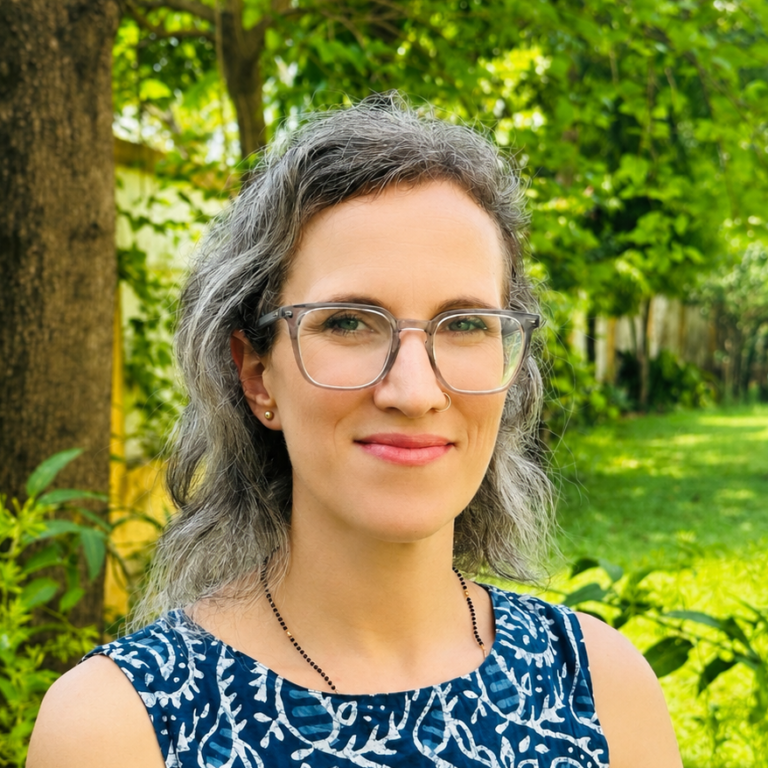
Lena Joshi
Co-Founder, Consultant, mentor, learner in the home learning space.
B.Ed. in Elementary Education – University of Victoria, Canada
MA in Educational Management and Leadership – University of Bath, United Kingdom
Certified teacher in British Columbia, Canada
Expertise and experience in various Canadian, European, and International Baccalaureate (IB) curricula. Home learning Educator
Lena’s story
Throughout my life, I have witnessed many ways of learning around the world. Growing up in Switzerland, I experienced a structured and well-established schooling system in which I thrived. But then, I had the opportunity to visit other countries where I saw how children interacted with and learned about the world in Namibia, Africa and later in Chile, South America in a much different, but just as valuable, way. This stark contrast in how learning can happen has stayed with me ever since.
Carrying this understanding into adulthood, and into my 13+ years of experience as a teacher, I have always had an open mind and heart for ways of learning that don’t quite fit in “the system”. Along the way, my heart was pulled more and more towards seeing the world a little differently, and this strengthened as I started walking the path of motherhood. I knew, even before they were born, that I would want my children to learn at their own pace and discover the world in a more explorative and holistic lens than what most schools can offer.
Little did I know then that all of this would be the precursor for a life as a home learning family.
All the diplomas, certificates, and learning that I have done in my career don’t mean much without the experience that came with them. It is life that teaches us. And what a gift it is to be able to allow your children to grow through life experiences rather than forced memorization of mundane, and often irrelevant, facts!